Cycle Rally for Panchen Lama

May 9, 2016

For Immediate Release:

Contact: Tamdin Hrichoe (Tibetan) +91 8894135363

Tsewang Dolma (English) +91 9882510131 Tenzin Wangchuk (Hindi) +91 8527338119

Cycle Rally for Panchen Lama

Dharamshala: In 1995 His Holiness the Dalai Lama recognized a young boy, Gedhun Choekyi Nyima, as the 11th Panchen Lama; the second most important spiritual leader in Tibet. Chinese authorities abducted Gedhun Choekyi Nyima and his family just weeks after; he was six-years old.

Gedhun Choekyi Nyima, the 11th Panchen Lama, and his family have been missing since 1995. The last time we had any information about his whereabouts was in 2010 when Chinese-appointed Tibet Governor, Padma Choling, told reporters that Gedhun Choekyi Nyima and his family are now living a good life as ordinary citizens in Tibet. China seeks to legitimize its rule in Tibet by claiming it plays a crucial role in the identification of Tibet’s two most important spiritual leaders, the Dalai Lama and in this case the Panchen Lama.

After repeated attempts to gain access to the boy, no international agencies or human rights organizations (including the United Nations) have been allowed to visit Gedun Choekyi Nyima or his family, and their condition remains uncertain. In an attempt to establish their authority over all “internal affairs” of China (political or otherwise) the Chinese leadership nominated and selected their own 11th Panchen Lama in November 1995. Their selection of six-year-old boy named Gyaltsen Norbu, is another young victim in China’s plan to undermine and control the Tibetan people, their faith, religion, and their nation.

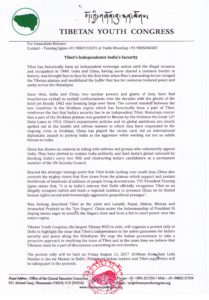
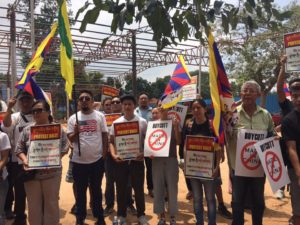
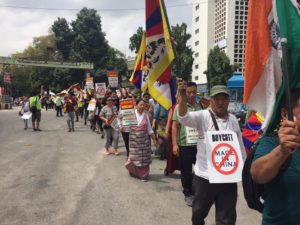
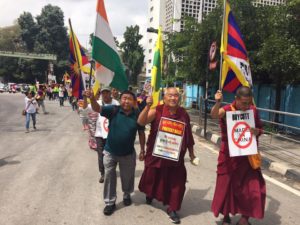
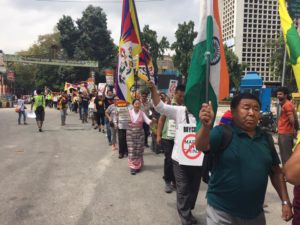
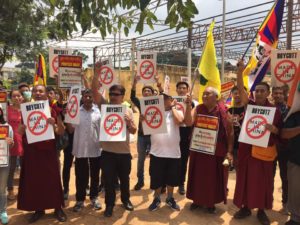
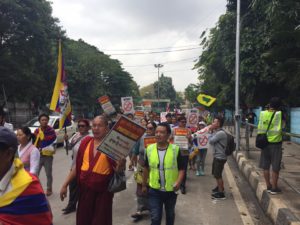
Tibetan Youth Congress (TYC) is organizing a ‘Cycle Rally for Panchen Lama’ to raise awareness about his situation, the condition of Tibetans living under the hardline policies of the Chinese government and show our solidarity to our brothers and sisters inside Tibet. We seek accurate information about Gedhun Choekyi Nyima’s whereabouts and wellbeing and we urge the United Nations as well as governments of the world to pressure the Chinese government to show us concrete evidence that Panchen Lama is indeed alive and well.

Demands:

  1. Urge China to give evidence that the 11th Panchen Lama Gendun Choekyi Nyima is alive
  2. Urge China to address the demands of the Self Immolations in Tibet
  3. Urge China to allow a fact finding international delegation to assess the situation inside Tibet
  4. Urge China to release all political prisoners

The cycle rally will begin from Dehradun on May 17, which is the day when Panchen Lama was arrested and end in Delhi on May 23, 2016. On May 23rd, 1951 the “17-Point Agreement” was signed between Tibet and China under Chinese pressure. “Ending the rally on May 23rd will highlight the facts about the 17 point agreement and our position which is we do not accept the agreement as it was signed under duress”, says TYC VP Tamdin Hrichoe. Tibetans from Dekyiling, Poanta Sahib, Puruwalla, Raipur, Rajpur, Herbertpur, Nainital, Mussorie, Delhi, Dharamshala and Bir Tibetan Settlements will be taking part in this cycle rally.

Tibetan Youth Congress is the largest Tibetan NGO in exile working for the Tibetan Freedom movement.

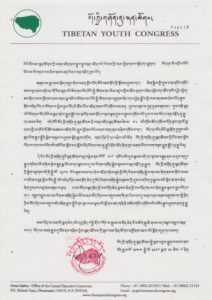
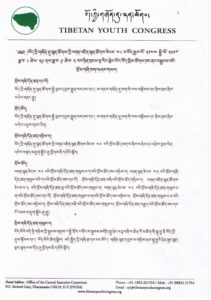
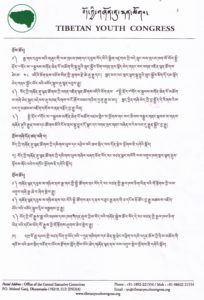
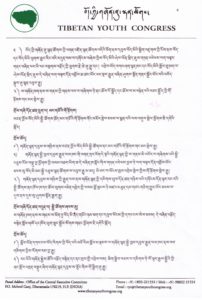
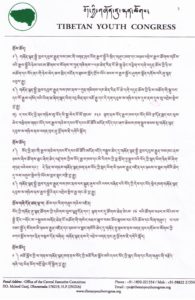
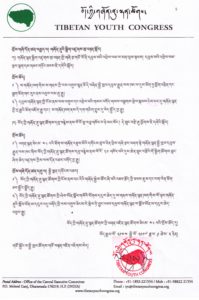
CR.statement.Tib CR.statement.Tib1

cycle rally final our demands

TYC President Interview with Tibet Sun

Majority of members not asking for change in stance: TYC President

Tibetan Youth Congress President Tenzing Jigme at his desk in McLeod Ganj, India, on 19 April 2016.

By Lobsang Wangyal

MCLEOD GANJ, India, 20 April 2016

The largest and most active exile Tibetan organisation, the Tibetan Youth Congress, landed in major trouble in 2013 after eight of the 88 regional chapters withdrew. Then another chapter, New York/New Jersey, was temporarily dissolved, plunging the organisation deeper into controversy.

The cause of the trouble was conflicting items in the aims and objectivesof the organisation, namely the first and the fourth clauses.

Clause one says: To dedicate oneself to the task of serving one’s country and people under the guidance of His Holiness the Dalai Lama, the Spiritual and Temporal Ruler of Tibet.

Clause four says: To struggle for the total independence of Tibet even at the cost of one’s life.

The Dalai Lama had proposed the idea of the ‘Middle-Way’ policy in the 70s, and officially declared the proposal in the European Parliament in Strasbourg in 1988. As a result of an opinion poll in 1997, the Central Tibetan Administration adopted the Middle Way as the official policy to resolve the Tibetan issue with China through dialogue and non-violence, settling for autonomy rather than independence for Tibet.

In May 2013 the eight regional chapters demanded a discussion on TYC’s aims and objectives in their general body meeting, after the Dalai Lama earlier that year expressly stated that independence was not possible to achieve, and affirmed his full confidence in the Middle-Way Policy. The TYC executive members refused to have a discussion, which led to the crisis.

The executive members toured South India earlier this month to try to reconcile with the renegade groups. But it’s not clear what the outcome was as the members were tight-lipped about the tour, and said more will come out in the near future.

Tibet Sun asked TYC president Tenzing Jigme to explain the current situation of the organisation.

TYC announced the termination of all the members of the New York/New Jersey Regional Tibetan Youth Congress (RTYC) in December, but they have refused to accept the order. What is the situation now? Are they still the RTYC New York/New Jersey?

The situation of RTYC/NYNJ is that the chapter still remains a part of TYC Centrex. We have withdrawn the decision to close the chapter, and they have agreed to remain a part of our organisation and abide by all our aims and objectives. So yes, they are still RTYC New York/New Jersey. I am very pleased to inform you that new board members of 14th RTYC/NYNJ were elected in our (Centrex) presence back in January. The matter has been resolved and the official handover to the new board took place on 16 April.

The members have claimed that their ouster by TYC Central was not according to the rules of the organisation. Why have they been ousted, and was their claim right about TYC Central’s disregard of the rules?

I think we need to be clear that no one was ousted by TYC Centrex. We made a decision to temporarily close the chapter, but no one was ousted by us. At the 45th and 46th TYC Working Committee Meeting, the quorum had adopted a resolution giving Centrex the full authority to make decisions on the eight chapters in India as well as New York/New Jersey. So we have not broken any rules regarding this matter.

There is growing demand within the TYC that clauses One and Four of the constitution of the organisation be reviewed, and a decision be made that either TYC follow the first clause and change the goal of TYC to ‘Middle-Way’, or remove the first and stick to Rangzen, as in the fourth clause. During the General Body Meeting in June 2013, eight RTYCs demanded a review of this issue. The demands were rejected by TYC Central, leading to the withdrawal of the eight RTYCs from the organisation. Now New York/New Jersey is asking the same about reviewing the two clauses. Why is this review not being done despite the calls? What is stopping TYC from doing a review?

The first clause of TYC aims and objectives is to follow the guidance of His Holiness the 14th Dalai Lama. I believe that should be the aim or principle of every Tibetan. Our fourth clause is to seek independence for Tibet, which is our right. I don’t think we need to give up seeking our right. Since the inception of the Middle-Way Approach in 1980 until now, over the last forty years we did not have any issues. TYC’s charter was formed in 1970. Both political stands have co-existed in the past without any problems. More importantly, what I really think needs to happen in our exile diaspora is that we need to comprehend ongoing discussions in our political discourse, and pay attention to elements that seem to be intruding into our society and our communities to divide us vis-a-vis Rangzen vs MW or Regionalism or Sectarianism.

We have eighty-eight chapters under our organisation. A few chapters have made demands to review or change our core aims, but like in any democratic organisation, for changes to take place it must happen according to the organisation’s rules and regulations. All articles of TYC’s charter can be reviewed and even amended through a process. If a majority of TYC chapters call for an article to be amended, then we as Centrex have to listen to their demands and bring that amendment to a discussion and ultimately vote on that new resolution at our General Body Meeting, which is the highest decision-making body of TYC. So we have always said that if you want change in TYC’s Charter, then you need to be a part of the process for change, and then you have to respect the decision of the majority. Out of eighty-eight chapters, eight chapters want TYC to change its political stand. That’s not a majority.

Among the eight chapters that had withdrawn from TYC, the four from South India form the biggest and most crucial chapters of TYC. Has their withdrawal caused any impact on the functioning of the organisation?

The eight chapters made a decision in 2013 that they would not be under TYC Centrex. Since then we have made several appeals to them to resolve the issue. Yes, four of the chapters belong to the biggest settlements in our Tibetan community in India, but I don’t know if they are the most crucial. It really depends on how you look at it. However, every chapter and member is important to us and we do understand the need for the organisation to remain united. Therefore, we are seeking a path to where we can resolve the issue with the chapters who have withdrawn from being under Centrex. If we are not able to resolve the issue then we will make a decision on their status, as a resolution was adopted at the 2015 46th TYC Working Committee Meeting in Delhi, that Centrex needs to make a clear-cut verdict on the eight chapters as well as New York/New Jersey.

TYC has been promoting itself as the NGO with the largest membership of any organisation in the exile Tibetan world. With the withdrawal of the eight RTYCs, what’s the difference in membership numbers between now and then?

We are truly blessed to have such an organisation like TYC, which gives Tibetans the opportunity to serve our country and our people. There is a whole new generation of young Tibetans both in exile and inside Tibet that are committing themselves to our struggle like never before. TYC thus plays a very important role in organising, educating, and mobilising [our youth] to channel their resources, their energy, and their spirit towards strengthening the struggle for Tibet’s freedom and independence.

Even though eight chapters have withdrawn from being under Centrex, there is no significant change in the membership of TYC as we have not received resignation of any individual members yet. As a matter of fact, I would think our membership has even grown stronger as we have witnessed younger Tibetans wanting to get involved in our struggle and be a part of this significant organisation — an organisation that China wants to see destroyed but which remains strong due to the spirit, determination, and courage of Tibetans to win their freedom back. The aspiration and resilience of Tibetans in exile and Tibetans inside Tibet for the freedom and independence of our nation is what will keep TYC thriving and our struggle alive.

TYC President Interview with Tibet Sun

Majority of members not asking for change in stance: TYC President

Tibetan Youth Congress President Tenzing Jigme at his desk in McLeod Ganj, India, on 19 April 2016.

By Lobsang Wangyal

MCLEOD GANJ, India, 20 April 2016

The largest and most active exile Tibetan organisation, the Tibetan Youth Congress, landed in major trouble in 2013 after eight of the 88 regional chapters withdrew. Then another chapter, New York/New Jersey, was temporarily dissolved, plunging the organisation deeper into controversy.

The cause of the trouble was conflicting items in the aims and objectivesof the organisation, namely the first and the fourth clauses.

Clause one says: To dedicate oneself to the task of serving one’s country and people under the guidance of His Holiness the Dalai Lama, the Spiritual and Temporal Ruler of Tibet.

Clause four says: To struggle for the total independence of Tibet even at the cost of one’s life.

The Dalai Lama had proposed the idea of the ‘Middle-Way’ policy in the 70s, and officially declared the proposal in the European Parliament in Strasbourg in 1988. As a result of an opinion poll in 1997, the Central Tibetan Administration adopted the Middle Way as the official policy to resolve the Tibetan issue with China through dialogue and non-violence, settling for autonomy rather than independence for Tibet.

In May 2013 the eight regional chapters demanded a discussion on TYC’s aims and objectives in their general body meeting, after the Dalai Lama earlier that year expressly stated that independence was not possible to achieve, and affirmed his full confidence in the Middle-Way Policy. The TYC executive members refused to have a discussion, which led to the crisis.

The executive members toured South India earlier this month to try to reconcile with the renegade groups. But it’s not clear what the outcome was as the members were tight-lipped about the tour, and said more will come out in the near future.

Tibet Sun asked TYC president Tenzing Jigme to explain the current situation of the organisation.

TYC announced the termination of all the members of the New York/New Jersey Regional Tibetan Youth Congress (RTYC) in December, but they have refused to accept the order. What is the situation now? Are they still the RTYC New York/New Jersey?

The situation of RTYC/NYNJ is that the chapter still remains a part of TYC Centrex. We have withdrawn the decision to close the chapter, and they have agreed to remain a part of our organisation and abide by all our aims and objectives. So yes, they are still RTYC New York/New Jersey. I am very pleased to inform you that new board members of 14th RTYC/NYNJ were elected in our (Centrex) presence back in January. The matter has been resolved and the official handover to the new board took place on 16 April.

The members have claimed that their ouster by TYC Central was not according to the rules of the organisation. Why have they been ousted, and was their claim right about TYC Central’s disregard of the rules?

I think we need to be clear that no one was ousted by TYC Centrex. We made a decision to temporarily close the chapter, but no one was ousted by us. At the 45th and 46th TYC Working Committee Meeting, the quorum had adopted a resolution giving Centrex the full authority to make decisions on the eight chapters in India as well as New York/New Jersey. So we have not broken any rules regarding this matter.

There is growing demand within the TYC that clauses One and Four of the constitution of the organisation be reviewed, and a decision be made that either TYC follow the first clause and change the goal of TYC to ‘Middle-Way’, or remove the first and stick to Rangzen, as in the fourth clause. During the General Body Meeting in June 2013, eight RTYCs demanded a review of this issue. The demands were rejected by TYC Central, leading to the withdrawal of the eight RTYCs from the organisation. Now New York/New Jersey is asking the same about reviewing the two clauses. Why is this review not being done despite the calls? What is stopping TYC from doing a review?

The first clause of TYC aims and objectives is to follow the guidance of His Holiness the 14th Dalai Lama. I believe that should be the aim or principle of every Tibetan. Our fourth clause is to seek independence for Tibet, which is our right. I don’t think we need to give up seeking our right. Since the inception of the Middle-Way Approach in 1980 until now, over the last forty years we did not have any issues. TYC’s charter was formed in 1970. Both political stands have co-existed in the past without any problems. More importantly, what I really think needs to happen in our exile diaspora is that we need to comprehend ongoing discussions in our political discourse, and pay attention to elements that seem to be intruding into our society and our communities to divide us vis-a-vis Rangzen vs MW or Regionalism or Sectarianism.

We have eighty-eight chapters under our organisation. A few chapters have made demands to review or change our core aims, but like in any democratic organisation, for changes to take place it must happen according to the organisation’s rules and regulations. All articles of TYC’s charter can be reviewed and even amended through a process. If a majority of TYC chapters call for an article to be amended, then we as Centrex have to listen to their demands and bring that amendment to a discussion and ultimately vote on that new resolution at our General Body Meeting, which is the highest decision-making body of TYC. So we have always said that if you want change in TYC’s Charter, then you need to be a part of the process for change, and then you have to respect the decision of the majority. Out of eighty-eight chapters, eight chapters want TYC to change its political stand. That’s not a majority.

Among the eight chapters that had withdrawn from TYC, the four from South India form the biggest and most crucial chapters of TYC. Has their withdrawal caused any impact on the functioning of the organisation?

The eight chapters made a decision in 2013 that they would not be under TYC Centrex. Since then we have made several appeals to them to resolve the issue. Yes, four of the chapters belong to the biggest settlements in our Tibetan community in India, but I don’t know if they are the most crucial. It really depends on how you look at it. However, every chapter and member is important to us and we do understand the need for the organisation to remain united. Therefore, we are seeking a path to where we can resolve the issue with the chapters who have withdrawn from being under Centrex. If we are not able to resolve the issue then we will make a decision on their status, as a resolution was adopted at the 2015 46th TYC Working Committee Meeting in Delhi, that Centrex needs to make a clear-cut verdict on the eight chapters as well as New York/New Jersey.

TYC has been promoting itself as the NGO with the largest membership of any organisation in the exile Tibetan world. With the withdrawal of the eight RTYCs, what’s the difference in membership numbers between now and then?

We are truly blessed to have such an organisation like TYC, which gives Tibetans the opportunity to serve our country and our people. There is a whole new generation of young Tibetans both in exile and inside Tibet that are committing themselves to our struggle like never before. TYC thus plays a very important role in organising, educating, and mobilising [our youth] to channel their resources, their energy, and their spirit towards strengthening the struggle for Tibet’s freedom and independence.

Even though eight chapters have withdrawn from being under Centrex, there is no significant change in the membership of TYC as we have not received resignation of any individual members yet. As a matter of fact, I would think our membership has even grown stronger as we have witnessed younger Tibetans wanting to get involved in our struggle and be a part of this significant organisation — an organisation that China wants to see destroyed but which remains strong due to the spirit, determination, and courage of Tibetans to win their freedom back. The aspiration and resilience of Tibetans in exile and Tibetans inside Tibet for the freedom and independence of our nation is what will keep TYC thriving and our struggle alive.

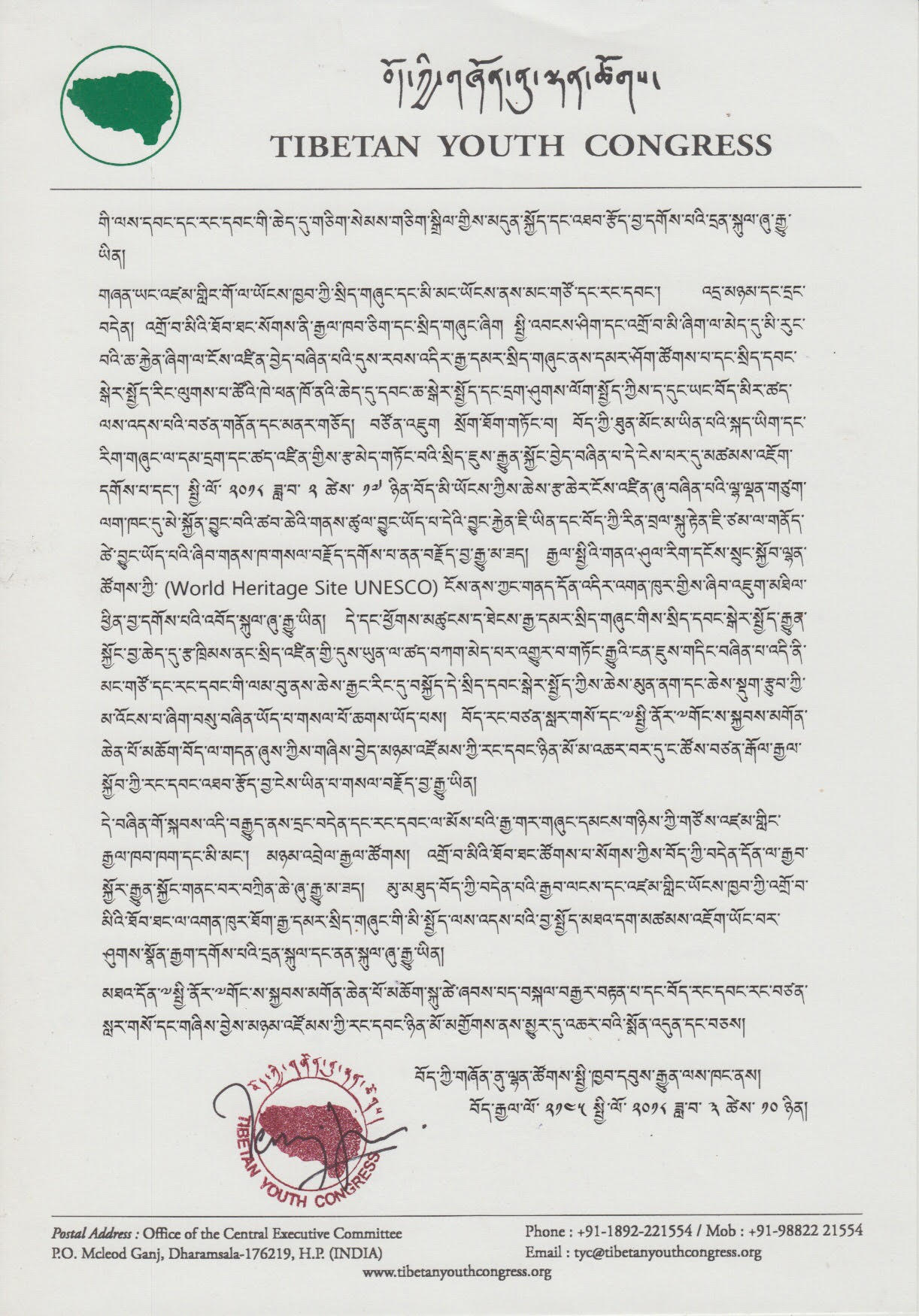
TYC Statement on the 57th commemoration of the Tibetan National Uprising Day on March 10

In the milieu of the great campaign for the restoration of the sovereign rights of the Tibetan people and of the Tibetan nation, we, to begin with, remember with incomparable deep respect the patriotic men and women who in heroic deeds have sacrificed their invaluable lives, especially the martyrs both in Tibet and in exile who have set themselves on fire, in pursuit of the cause. So also the kith and kin they have left behind, the heroic men and women of patriotic fervour who to this day endure multitude of suffering in Chinese prisons, and, likewise, all our brethrens left behind in Tibet who have been rendered bereft of any right to enjoy any of the rights enshrined in the Universal Declaration on Human Rights of the United Nations. To all of them we offer our support and solidarity borne of a shared heartfelt feeling of suffering.

On this day of 10th March in 1959, many tens of thousands of heroic men and women from all the three traditional provinces of the Snowland of Tibet rose to the defence of their historically defined sovereignty and national leader with indomitable courage and spirit of self-sacrifice. With shouting in unison of slogans offering prayers of long life for His Holiness the Dalai Lama, asserting that Tibet was an independent country and is hH demanding that China quit Tibet, they rose to resist and stage an uprising against the government of China. This is therefore a particularly important day, for it marks a historic occasion when the Tibetan people made manifest their sense of loyalty and courage as the people of the Snowland of Tibet. We should, whether as members of any organization or as private individuals, commemorate the March 10 Tibetan National Uprising Day with a sense of unity, forgetting as a distant memory our parochial stands and provincial biases. Besides, we should bear in the core of our hearts the demands raised by our patriotic brethrens and the slogans shouted by them on that historic occasion. And it is on this basis that we should seek to further our historically defined just cause, the aspiration of our ancestors, and the indomitable courage shown by the heroic fellow-Tibetan men and women. And we wish to remind and reiterate that with unity of purpose, we should work to enhance our campaign of resistance against the occupation of our homeland and national protection.

With shameless audacity, the government of China keeps propagating all sorts of falsehood about the existence of progress, freedom, and happiness in Tibet under its rule. In particular, by converting many places in Tibet into tourist resorts and carrying out various kinds of projects in Tibetan-inhabited towns and villages, creating a glittering outward atmosphere, China strives to convey an impression that the situation in Tibet is marked by continuing progress. However, the stark reality remains that the Tibetan people have no freedom to enjoy the fruits of any of these outward symbols of progress and modernization. Worse, because of those projects, Tibetans have lost their homes and land. Large numbers of Chinese have moved into Tibet, inflicting severe adverse consequences on the Tibetan people’s traditional mentality, material well being, traditions, customs, and so on. These are parts of China’s relentless efforts directed at decimating out of existence the Tibetans as a people, and their linguistic and cultural heritage.

Since it occupied the entire territory of Tibet in 1959, the communist government of China has carried out a series of cruel and barbaric policies directed at destroying the Tibetan people’s religious traditions, language, culture, and so on. In the face of these continuing onslaughts, the Tibetan people, being tested to the limits of their endurance, countered with an equally relentless series of peaceful protests directed at protecting their fundamental human rights and freedoms of religion, language, and culture in a campaign directed, in the final analysis, at the restoration of their national sovereignty. Likewise, in 2008, Tibetans across the land launched the peaceful uprising protests of the Earth-Mouse Year. In particular, to this day, some 149 Tibetans – including monks, nuns, and laypeople, as well as young and old – have set themselves on fire while protesting against the policies and occupation rule of the Chinese government, raising demands that His Holiness the Dalai Lama, their supreme leader, be invited back to his homeland and Tibet’s freedom and independence be respected. In 2015 alone, seven Tibetans have set themselves on fire while carrying out such protests. During the past more than six decades, over 1.2 million Tibetans have lost their lives under the violent repression and oppression of the Chinese government while campaigning to resist the occupation rule and to protect their country. And most of the 149 Tibetans who carried out protest self-immolations have died.

In order to realize their fundamental human rights and national sovereignty, the Tibetan people have adopted the non-violent method and taken recourse to a variety of perfectly reasonable means to express their demands to the government of China as well as to governments of other countries. However, the government of China has totally ignored the aspirations of the Tibetan people and kept on trampling on their fundamental human rights, implementing on them policies of unprecedented control. Under it, Tibetans, even when travelling within their homeland, whether for purposes of pilgrimage or visiting relatives or other purposes, have to submit to a series of checkpoints set up by the Chinese government and be thereby subjected to severe restrictions on their movement. In particular, during traditional Tibetan ceremonial events, armed Chinese troops are deployed in large numbers to subject the Tibetan people to intimidation. Laws and decrees are issued at will everywhere to subject the Tibetan people to frequent spells of repression and intimidation.

The government of China criminally brands Tibetans who carry out peaceful protests as people who disturb social order, terrorists, and so on and sentence them to execution or long term imprisonments. Likewise, it subjects monasteries, villages and towns, and families, and relatives and acquaintances of people related to such protesters to all manners of harassment and intimidation. And it also, to this day, continues to subject Tibetan intellectuals to hostility and controls in order to achieve its aim of obliterating the Tibetan language and culture.

According to the report for 2015 published just recently by the Tibetan Centre for Human Rights and Democracy, there are, as of now, a total of at least 2081 political prisoners across Chinese ruled Tibet, and of them 967 are monks and nuns. Sixty-eight of them were sentenced in 2015 alone.

One of the most recent examples among them was the case of the young Tibetan writer Shogjang. The Intermediate People’s Court of Malho Tibetan Autonomous Prefecture in Qinghai Province on 16 February 2016 held him guilty of carrying out activities amounting to ethnic separatism and harming social stability through his writings and so sentenced him to a jail term of three years. And back in 2002, prominent Tibetan religious figure Tulku Tenzin Deleg Rinpoche was arrested and killed after being subjected to torture and ill-treatment beyond all limits in prison for a period of a little more than 13 years. At that time the family, relatives, and friends of Rinpoche as well as the local Tibetan public appealed to the prison authorities to deliver to them his body. But the Chinese government not only refused to give custody of his body to his family but also denied them any opportunity to even carry out the last rites for him in accordance with the Tibetan customs and traditions.

On 4 January 2016, an order was issued by the Chinese authorities in Draggo County of Karze Tibetan Autonomous Prefecture in Sichuan Province, formerly part of the traditional Tibetan province of Kham, making it imperative for the local Tibetan people to surrender all pictures of His Holiness the Dalai Lama in their possession by the deadline of 2 February 2016. The order also banned Tibetans from displaying pictures of His Holiness the Dalai Lama. The order said those who failed to comply with the deadline or to surrender the pictures would be severely punished according to law. In connection with cases such as these, Mr. Christoph Strässer, the Federal German Government Commissioner for Human Rights Policy and Humanitarian Aid, severely criticized the Chinese government, saying people in Tibet devoted to His Holiness the Dalai Lama were being not allowed to freely practice their religion, that the government of China considered His Holiness the Dalai Lama a separatist and those who were devoted to him were in constant danger of having their rights infringed. He added that this also led to more arrests and very unpleasant situations for such Tibetans. Likewise, Freedom House, the US-based human rights research organization, revealed in its most recent global annual survey report that the situation of civil liberties and political rights in Tibet under Chinese rule during 2015 was the second worst in the world. Also, Ms. Sophie Richardson, the China director for Human Rights Watch, has said China had increased its surveillance on the daily lives of the Tibetan people, that in gross violation of its own constitution as well as in total negation of the international law and other principles, China continued to be in serious violation of the human rights of the Tibetan people. She has added that under Chinese rule the Tibetan people continued to be subjected to strict surveillance while exercising their religious freedom and in the course of pursuing their daily personal lives. Besides, on 8 October 2015, the Congressional-Executive Commission on China of the United States severely criticized China in its annual report for 2015, saying that by implementing a policy of severe restrictions it denied Tibetans adequate rights to protect their culture, language, religion, and environment. Likewise, in their report the United Nations Refugee Agency has revealed China to be the country with the worst human rights situation in the world. The above few examples provide stark evidences that the situation in Tibet with regard to human rights and religious freedom, linguistic freedom, and so on, has reached a truly critical stage.

If it is already not too late for the government of China to acknowledge and assume responsibility for the criticality of the situation in Tibet today with regard to the above matters, we emphatically reiterate that it bear accountability for the life and aspirations of the Tibetan people and forthwith put an end to its violent occupation rule. Besides, the situation in Tibet has a direct bearing on the world in general terms and especially on peace and harmony across the whole of Asia. Therefore, we strongly appeal to people across the world who support peace and justice and especially to their governments to take a stronger position on Tibet than they have thus far and bring pressure on the government of China in efforts directed at realizing a meaningful outcome.

On another matter, the government of China has in recent times been shamelessly asserting the complete right to dictate all aspects of the process in the ancient Tibetan tradition leading to the recognition of reincarnations, or Tulkus, of lamas of Tibetan Buddhism, especially with respect to the future recognition of the reincarnation of the present, 14th Dalai Lama. We see this as nothing more than a brazen move by the government of China to interfere in the Tibetan religious practice concerned with recognizing the reincarnations, or tulkus, of its lamas. The truth remains, nevertheless, that the government of China has absolutely no right to interfere in the matter of recognizing the reincarnations of Tibetan lamas; least of all, in the case of the recognition of the reincarnation of the Dalai Lama. The Tibetan Youth Congress is absolute in its protest against this unimaginably brazen claim and the pursuant actions of the government of China. We would also like to make it a point to remind the Chinese government that it is only the senior lamas of Tibet and the Tibetan people who alone have the power and responsibility in the matter of recognizing the reincarnations of the Dalai Lamas.

On 15th April last year, the government of China said in a so-called white paper released by it that the 14th Dalai group leadership employed various strategies to incite Tibetan lamas and lay followers inside China to engage in acts of self-immolation, leading to a series of such incidents in a number of regions. And it also said, “The Tibetan Youth Congress not only schemed and incited ill-informed people to engage in violence, but also actively trained armed and reserve forces. They set up military training bases in Dharamsala, India, and established the ‘Tibetan Freedom Fighters Association’ to carry out armed sabotage and sent people to contact international terrorist organizations to seek mutual support. TYC has had a hand in many incidents of violence and terror in Tibet and other places in China.” The so-called white paper was filled with such brazenly false and baseless claims. The Tibetan Youth Congress takes this moment to again reiterate our resolve never to acknowledge the veracity of such utterly baseless and distorted claims made by the government of China. On the issue of the peaceful protest campaigns, including the protest self-immolations, taking place in Tibet, the fundamental cause lies entirely in the occupation rule and brutal polices of repression being implemented by the government of China. Beijing therefore must bear total responsibility for these tragic developments.

The Tibetan Youth Congress also takes this opportunity to remind everyone that the situation in Tibet has been continuing to deteriorate rapidly from bad to worse, that Tibetans left behind in Tibet have now reached the stage of adopting the highest level of non-violent action in their struggle for the cause of the Tibetan people and for the realization of their national sovereignty, unmindful of all dangers to their lives. We the Tibetan people living in exile should, on the basis of remembering the gratitude we owe to them for their patriotism and courage, take ever greater responsibility in the struggle for the Tibetan cause. The time to do so is now and we make our appeal accordingly. At the same time we reiterate our appeal to the Tibetan public during this year for the elections of the Sikyong and the members of the Tibetan parliament in exile as a matter of utmost importance to exercise their democratic rights and duties without being in violation of ethical principles. As far as we at the Tibetan Youth Congress are concerned, we again make clear our resolve that so long as the government of China does not end its occupation rule in Tibet, the struggle to regain our national independence will not see a conclusion.

To the people and government of India as well as to all the governments, organizations, and individuals internationally who in body and spirit have provided us genuine support, we take the opportunity provided by this occasion to express our immense gratitude.

Finally, we pray that His Holiness the Dalai Lama, the supreme leader of the Tibetan people, as well as all the other great spiritual masters of Tibet may live a truly long life; that the just Tibetan cause for national independence may be realized with speediness, so that the Tibetan people living in exile and those left behind in their homeland be reunited.

– Issued by the Central Executive Committee of the Tibetan Youth Congress, Dharramshala
10 March 2016, the Tibetan Royal Year 2043

tib1

tib2

tib3

tib4

hin1

hin2

hin3

hin4

eng1

eng2

eng3

eng4

eng5

TYC Hunger Striker Hospitalized on 21st Day

Delhi Sept 30: At 11:21pm last night TYC Hunger Strike Tsewang Dolma was hospitalized and escorted by Police to RML Hospital in Delhi. While we pray for a quick recovery for her we are outraged that the UN has still not responded to the cries of the Tibetan people.

Tibetan Youth Congress “Indefinite Hunger Strike” for Tibet campaign started on Sept 10 at Jantar Mantar in Delhi and today is the 22nd day of this campaign. Three TYC Executives Tamdin Hrichoe, Tenzin Wangchuk and Tsewang Dolma are participating in this hunger strike. As Tsewang Dolma is being treated at the hospital, the hunger strike continues with Tamdin Hrichoe and Tenzin Wangchuk.

In response to China’s propaganda and in order to create awareness about the critical situation in Tibet; to support the demands and aspirations of the self-immolators; and to show solidarity with Tibetans inside Tibet, the Tibetan Youth Congress has initiated this “Indefinite Hunger Strike”. This campaign is aimed at the United Nations who we believe must act immediately and hold China responsible for their actions in Tibet.

Our demands to the United Nations are as follows:

1.Urge the United Nations member states to raise the issue of Tibet at its General Assembly and Human Rights Council Session
2.Urge China to address the demands of the Self Immolations in Tibet
3.Urge China to give evidence that the 11th Panchen Lama Gendun Choekyi Nyima is alive
4.Send a fact-finding UN delegation to assess the current critical situation in Tibet
5.Urge China to release all political prisoners

Tibetan Youth Congress is the largest Tibetan youth organization (NGO) in exile. Through non-violence campaigns, we vow to keep the struggle for Tibet alive until the issue is resolved.

####

TYC Indefinite Hunger Strike Called Off

For Immediate Release:

Contact: Tenzing Jigme +91-9882910291

Victory: TYC Indefinite Hunger Strike Called Off

Delhi Oct 11: On the 32nd day of the Indefinite Hunger Strike, Tibetan Youth Congress has called off the campaign after receiving assurance from the United Nations that they will address the demands of TYC. In a letter to TYC Hunger Strikers, UN Assistant Secretary General of the Office of the Human Rights Commissioner Ivan Simonovic requested the hunger strike to cease and assured TYC that the voices of the Tibetan people will be heard. He also stated that the UN Secretary General Ban Ki Moon expressed concern at the health of the hunger strikers. The letter was delivered to TYC by Yuri Afanasiev the UN Resident Coordinator and UNDP Resident Representative in India. TYC President Tenzing Jigme said, “this is a huge victory for the Tibetan people.” He added that, “the power of non-violence methods of resistance and the fact that when we come together and fight for our country as one – we win, is evident from this victory.”

CD3_3128TYC launched the Indefinite Hunger Strike on Sept 10 and three TYC executives Vice President Tamdin Hrichoe, Finance Secretary Tenzin Wangchuk, Information and International Relations Secretary Tsewang Dolma took part in this campaign. On Sept 30, the police citing deteriorating health condition took Tsewang Dolma to the hospital.

The campaign has witnessed huge support and solidarity from Tibetans all over the world as well as Indian leaders and members of community. Visits to the hunger strikers from various Indian Members of Parliament, former Ministers, social activists, student organizations and supporters of Tibet were seen.

Tibetan Political Leader Sikyong Lobsang Sangay, Home Minister Kalon Gyari Dolma and Information Minister Dickyi Choyang also visited the hunger strikers and paid their respects and solidarity. Tibetan Parliament in Exile’s Deputy Speaker and Executive Member Monlam Tharchin as well as Members of Parliament Dawa Phunkyi, Dhadon Sharling, Yangchen Dolkar, Acharya Yeshi Phuntsok, Kusho Thubten Wangchen, Karma Yeshi, Norbu Tsering, Wangpo Tethong, Tsering Youdon, Lobsang Yeshi, Gyari Bhutuk, Chokyong Wangchuk, Youdon Aukatsang and Mogru Tempa visited the hunger strikers. Chitue Karma Choephel couldn’t visit due to personal health reasons but sent in his solidarity.

With three aims and five demands the campaign been successful in accomplishing its goals and has inspired a whole new CD3_3127generation of young Tibetans invoking a sense of renewed nationalism and patriotism in the Tibetan freedom movement. “Support from students, youth and members of the community has been great”, said Tamdin Hrichoe. “That kind of support and unity is very important in our struggle and must continue in order for us to win our country back,” added Hrichoe.

A Solidarity Unplugged Concert with Indian Rock Band Parikrama and Poetry for Peace events were also organized at the hunger strike site. This was something new and never done before. “The idea is that we have to use all our resources, ideas and be strategic, therefore such events help us in achieving our overall goals,” said Jigme.

TYC hunger strike participants will now be taken to the hospital for evaluation and necessary medication to recover.

Back To Top