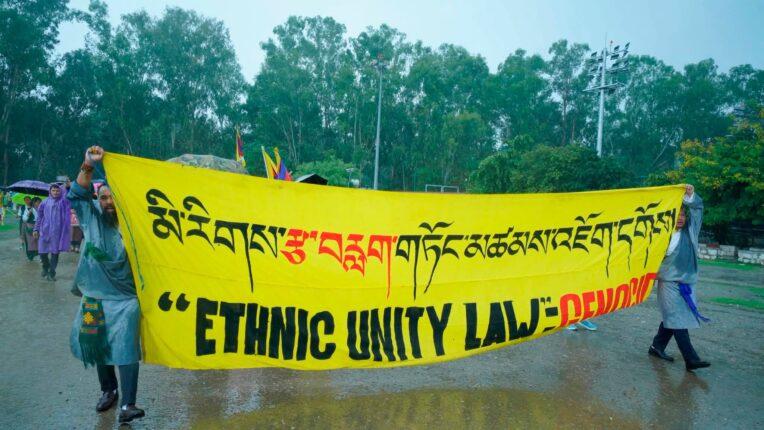
On 1 July 2026, as the People’s Republic of China implemented its so-called “Ethnic Unity and Progress Law,” Tibetans around the world stood united in opposition to an unjust law aimed at undermining the distinct identity of the Tibetan people.
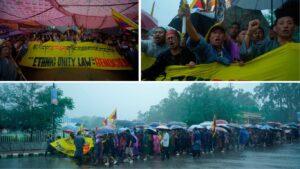
During its ongoing 55th Working Committee Meeting, the Tibetan Youth Congress (TYC) organized a protest in Dehradun under the banner “POMEGRANATE PROTEST: Abolish the Ethnic Unity Law.” The protest campaign condemned the implementation of the law, as it is the gravest threats to Tibetan identity, language, culture, and religion in recent decades.
With the Central Executive Committee and representatives from more than 30 Regional Chapters gathered for the 55th Working Committee Meeting, members of the Tibetan Youth Congress came together in a united display of resistance against the law and reaffirmed their commitment to safeguarding the rights and identity of the Tibetan people.
The protest was further strengthened by the participation and solidarity of members from Bharat Seema Jagran Manch, Bharat Tibet Sahyog Manch (BTSM), and Bharat Tibet Mitra, who joined the demonstration in support of the Tibetan cause.
TIBETAN YOUTH CONGRESS STATEMENT:
The Tibetan Youth Congress (TYC) strongly condemns the implementation of the so-called People’s Republic of China’s “Ethnic Unity and Progress Law,” which comes into force on the 105th founding anniversary of the Chinese Communist Party. This legislation represents one of the most serious threats to the survival of Tibetan identity in recent decades.
Under Han-dominated leadership, Beijing continues to consolidate its unilateral control by institutionalizing policies aimed at assimilating Tibetans through political repression, cultural interference, economic domination, and coercive state measures. More than six decades after the occupation of Tibet, the Chinese Communist Party has intensified its campaign to Sinicize Tibet under the guise of promoting “ethnic unity.” By advancing a single Han-centric national identity.
The pomegranate metaphor seeks to portray all ethnic groups as inseparable parts of a single Chinese national identity. However, Tibet’s distinct civilization, language, religion, and historical experience cannot be reduced to a seed within another nation’s narrative. True coexistence must be based on respect for identity, not assimilation.
The concerns raised by the United Nations High Commissioner for Human Rights and various UN Special Rapporteurs clearly demonstrate that China’s assimilation policies violate internationally recognized human rights standards, including the rights to culture, language, religion, and self-determination.
Therefore, the Tibetan Youth Congress calls upon:
1. The Government of India and democratic nations worldwide to unequivocally condemn China’s forced assimilation policies in Tibet.
2. The United Nations Human Rights Council and its member states to take concrete multilateral action to address the deteriorating human rights situation in Tibet.
3. The People’s Republic of China to immediately abolish the colonial boarding school system and cease all policies aimed at erasing Tibetan identity, language, religion, and culture.
4. The international community, governments, and human rights organizations to closely monitor the implementation of this law and hold the Chinese government accountable for policies that threaten the survival of Tibetan identity and violate internationally recognized human rights norms.
The implementation of this law marks a dangerous turning point in China’s policies toward Tibet. If left unchallenged, it threatens the intergenerational transmission of Tibetan language, religion, and culture, and risks the irreversible destruction of the Tibetan nation’s unique identity and heritage.
The Tibetan Youth Congress unequivocally condemns and rejects this genocide law. As we declared during the Black Hat March Campaign in April, we once again raise our voice in opposition to this assimilationist legislation, which stands in direct contradiction to the principles enshrined in the United Nations Charter, international human rights standards, and fundamental freedoms. Such measures undermine cultural diversity, religious freedom, and the right of communities to preserve, protect, and develop their own identity, language, and way of life.
On this 1 July, Tibetans across the world stand united in defense of our identity, culture, and fundamental rights, as well as our collective aspiration for a Free and Independent Tibet. We call upon global leaders, democratic governments, human rights defenders, and people of conscience everywhere to stand in solidarity with Tibet and resist all attempts to erase the identity, dignity, and existence of the Tibetan people. The struggle for Tibet is not only a struggle for one nation—it is a struggle for justice, human dignity, cultural survival, and the universal right of all peoples to live freely and determine their own future.
“Injustice anywhere is a threat to justice everywhere. We are caught in an inescapable network of mutuality, tied in a single garment of destiny. Whatever affects one directly, affects all indirectly.” – Martin Luther King Jr., Letter from the Birmingham Jail