
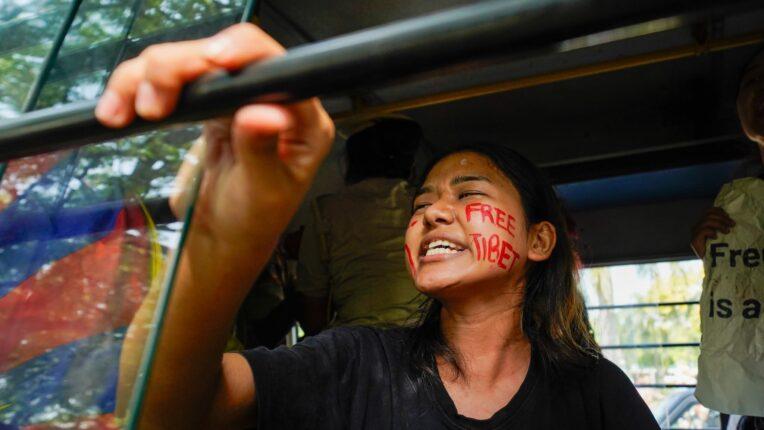
On 1 October 2026, more than 40 members of the Tibetan Youth Congress (TYC) staged a peaceful protest in front of the Chinese Embassy in New Delhi to mark the founding day of the so-called People’s Republic of China. Following the demonstration, all participating activists were detained by the Delhi Police and taken to Mandir Marg Police Station. The protest was a powerful expression of Tibetan resistance and remembrance on a day that is celebrated by the Chinese government, but carries a profoundly different meaning for Tibetans.
The People’s Republic of China was founded on 1 October 1949, a date that Tibetans remember in the context of the subsequent Chinese occupation of Tibet and the profound political, cultural, and social upheaval that followed. While the Chinese government presents its expansion into Tibet under the narrative of “liberation,” Tibetans continue to question the reality and consequences of that claim. For the Tibetan people, liberation cannot mean the loss of a nation’s freedom, the suppression of its identity, or the weakening of its language, culture, and traditions. Liberation does not equal occupation.
As China celebrated its national day, Tibetan protesters stood outside its embassy to remind the world that behind official celebrations lies a history that remains deeply painful for the Tibetan people. Their presence in New Delhi reflected the enduring grief of a people separated from their homeland, but also the courage and determination of a younger generation unwilling to allow Tibet’s history and identity to be forgotten. Carrying the aspirations of those who sacrificed for Tibet, the protesters raised their voices peacefully for freedom, justice, human rights, and Rangzen.The demonstration also served as a reminder that Tibetans continue to resist cruel Chinese policies that threaten the survival of their distinct national identity. Despite detention and the restrictions placed on peaceful expression, the spirit of the protesters remained resolute: Tibetan voices will not be silenced, Tibetan identity will not be erased, and the aspirations of the Tibetan people will continue to be carried forward.
For Tibetans, 1 October is therefore not simply a date on a political calendar. It is a day of remembrance, reflection, and renewed determination. While one side celebrates the founding of a state, Tibetans remember the consequences that followed and continue to call for a future in which Tibetans can live with dignity, freedom, and self-determination in their own homeland.