TIBETAN YOUTH CONGRESS STATEMENT
113th Anniversary of Tibet’s Declaration of Independence
(13 February 1913)
On the 113th anniversary of Tibet’s Declaration of Independence, the Tibetan Youth Congress (TYC) once again reaffirms that Tibet has always been an independent nation and shall remain so. Contrary to the false claims propagated by the so-called People’s Republic of China (PRC), Tibet’s historical relationship with neighbouring powers, including the Mongol Khans and later the Ming and Manchu (Qing) emperors, was based on the Preceptor Patron (Chö-yon) relationship. This relationship was one of mutual spiritual and material support and never one of political subordination. At no point did it signify Tibet’s incorporation into China as a sovereign territory.
Following China’s unlawful invasion of Tibet, the PRC constructed a fabricated historical narrative to justify its actions under the guise of “liberation,” falsely asserting that Tibet and China are one nation. However, extensive historical evidence, from Tibet’s imperial period through the early twentieth century, clearly demonstrates Tibet’s status as a distinct and independent country.
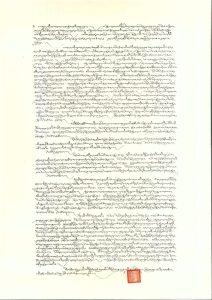
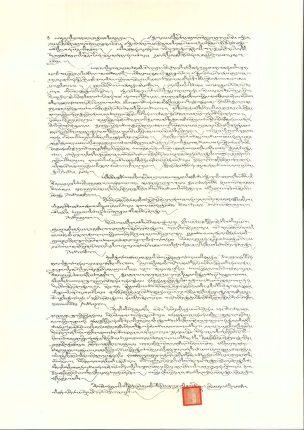
A particularly compelling example lies in the reign of His Holiness the 13th Dalai Lama. On 13 February 1913, after the collapse of the Manchu Qing dynasty, His Holiness issued a proclamation declaring Tibet’s independence. This declaration followed years of Chinese military aggression in eastern Tibet and the deployment of Chinese troops to Lhasa under the pretext of safeguarding Tibet. Despite repeated clarifications that Tibet’s relationship with China was spiritual rather than political, Chinese forces attempted to abduct and assassinate His Holiness, which ultimately forced him into exile in India.
After the fall of the Qing dynasty, Tibetans from all social strata successfully expelled Chinese troops from central Tibet. Upon his return to Lhasa, His Holiness the 13th Dalai Lama issued a Five Point Decree. In the fourth point, he clearly stated: “Though not prosperous or technologically advanced like other countries, Tibet is an independent nation living in peace and governed by religious principles.”
Further evidence of Tibet’s independence can be found in the 1888 Sikkim Expedition, as documented in British historical records. In 1890, the British government signed a treaty with China concerning the Tibet-Sikkim border and trade relations. This treaty later became ineffective when the British realized that Tibet was not bound by it and that China had no authority to enforce it within Tibet. This realization implicitly acknowledged Tibet’s independent status.
Even the so-called Seventeen Point Agreement of 1951 serves as evidence of Tibet’s independence, as China deemed it necessary to negotiate and obtain signatures from Tibetan representatives rather than exercising sovereign authority.
Tibet’s system of governance has always been unique, with His Holiness the Dalai Lama serving as both the spiritual and temporal leader. Therefore, religion plays a central role in Tibetan political and social life. In 2007, the Chinese State Administration of Religious Affairs issued Order No. 5, asserting state control over the recognition of reincarnated Tibetan lamas. This order requires government approval for religious reincarnation and represents a direct interference in Tibetan Buddhism.
In 1995, Chinese authorities abducted the 11th Panchen Lama, Gedhun Choekyi Nyima, and appointed a state-selected alternative. This act was intended to control the future recognition of the Dalai Lama’s reincarnation and further undermines Tibetan religious freedom under the watch of the international community.
Tibet’s struggle for independence is firmly grounded in international law, particularly the right to self-determination as enshrined in the Charter of the United Nations and the International Covenant on Civil and Political Rights. The Tibetan people, as a distinct nation with a unique history, culture, language, and governance system, are entitled to freely determine their political status and pursue their economic, social, and cultural development without external coercion.
The Tibetan Youth Congress reiterates that the Tibetan freedom movement is fundamentally non-violent and rooted in democratic values, justice, and respect for human rights. To the United Nations, its member states, parliamentarians, international organizations, supporters of Tibet, democratic nations, political activists, and environmentalists, we express our hope that you will continue to stand in solidarity with the Tibetan cause. We urge the international community to acknowledge Tibet’s historical status, to hold the People’s Republic of China accountable for its violations of international law, and to work collectively to end the suffering of the Tibetan people.
On this solemn anniversary of Tibet’s Declaration of Independence, the Tibetan Youth Congress declares that it will not bend under Chinese oppression and will continue its peaceful and determined struggle for the restoration of Tibet’s independence.
ONE DAY TIBET WILL BE FREE, VICTORY OF TIBET
Tibetan Youth Congress